
Winter OCD News (June 2026)
A warm welcome to the winter issue of OCD in Australia News!
🗞️ Research News
A few recent highlights:
More explanations for how obsessive-compulsive concerns take hold: Australian researchers across three institutions ran an experiment which indicated that a “feared self” (dreading secretly being a bad, dangerous, or immoral person) drove stronger obsessive-compulsive reactions when people also have an inflated sense of responsibility.
Researchers in Spain conducted a huge “review of reviews” and reaffirmed what works best for OCD in young people. They synthesised 28 systematic reviews and meta-analyses (representing almost 25,000 participants), and concluded that cognitive behavioural therapy, with exposure and response prevention in particular, has the most research evidence for children and adolescents with OCD, with medication a useful add-on in more severe cases.
There’s also a new high-level update on the science of what’s happening in the brain and body in OCD. It covers how OCD runs in families, the brain circuits involved (which often settle down after successful treatment), and the emerging role of a chemical messenger (glutamate). It also stresses that biology and psychology work hand-in-hand, and that the most promising future treatments will likely combine both. This is a good big-picture update for any professional wanting to understand OCD beneath the symptoms.
🙋 Get involved in research
If you’re interested in helping others with OCD, consider participating in research or sharing it with others. Here’s what’s currently recruiting:
Are you a fiction reader with lived experience of obsessive-compulsive disorder?

Researchers at the University of Southern Queensland (UniSQ) are interested in any fictional portrayals of obsessive- compulsive disorder you’ve come across (‘OCD fiction’) and what it was like for you to read them.
This project, which is being undertaken as part of a UniSQ Master of Editing and Publishing, aims to offer preliminary insights into the responsible representation of OCD in fiction and to identify opportunities for further research.
You’re invited to contribute via an anonymous online survey. Participation is voluntary, and you may provide as much or as little information as you feel comfortable sharing.
To learn more, access the survey and/or get in touch with the research team, visit the survey landing page.
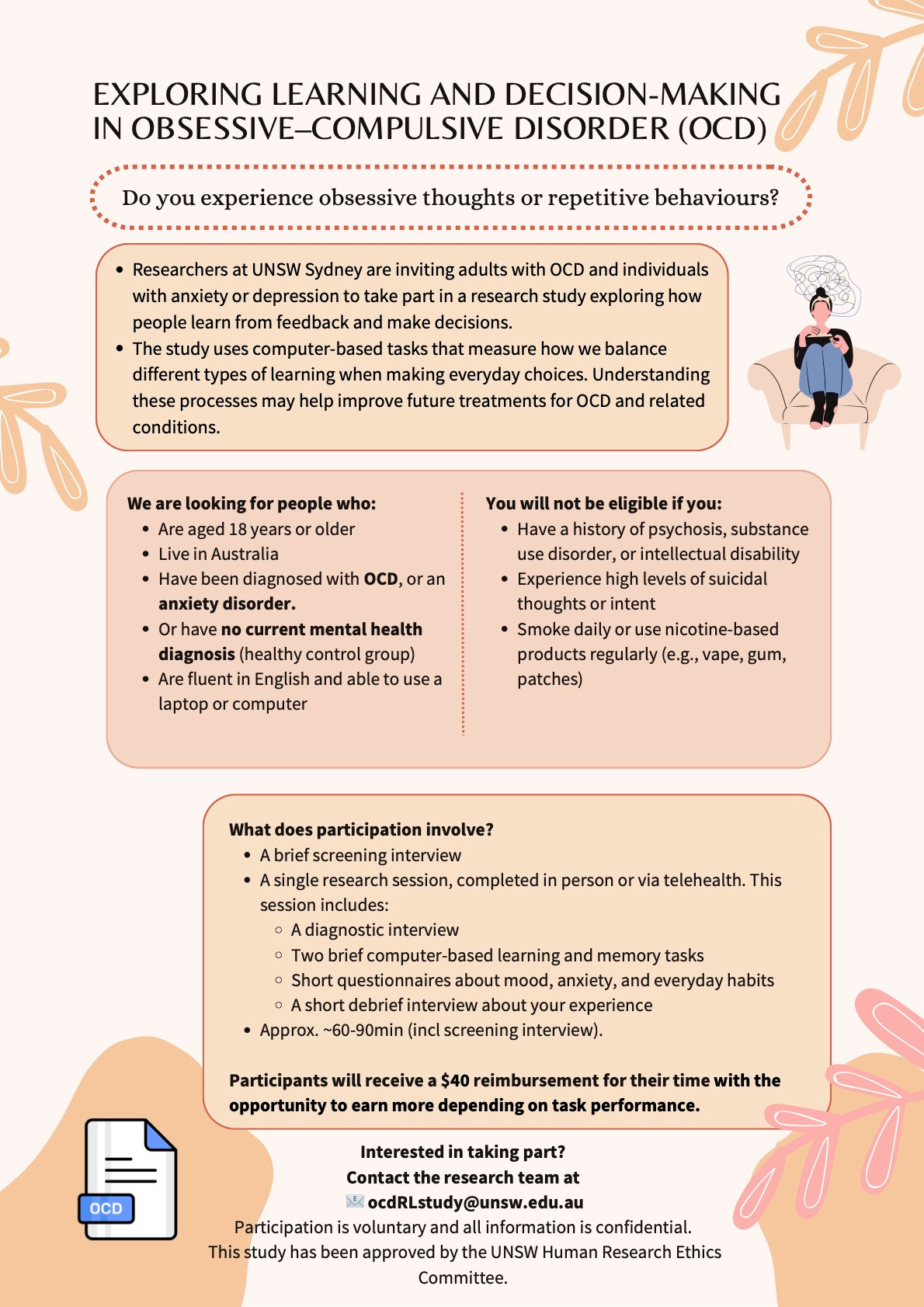
Exploring learning and decision-making in OCD
Researchers at UNSW Sydney are inviting adults with OCD and individuals with anxiety or depression to take part in a research study exploring how people learn from feedback and make decisions. Details are provided in the below flyer. Interested in taking part? Contact the research team at ocdRLstudy@unsw.edu.au.
Researchers: If you’re recruiting for a study involving OCD (with HREC approval in Australia) contact us for inclusion in the next newsletter.
🔎 Directory updates
Looking for support with OCD? Here are the most recent additions to our directory:
Dylan Fuller is a psychologist and clinical registrar based in Parramatta, who provides therapy (including ERP) for adolescents to older adults.
Dr Maggie Hall is a clinical psychologist based in Melbourne, who provides assessment and therapy (including ERP) for adults and older adults.
Dr Nisha Sethi is a clinical psychologist in Gordon (NSW), who provides assessment and therapy (including ERP) for adults.
These clinicians join over 150 others with a special interest in treating OCD. You can find support by searching the directory here.
Providers: Learn how you can join the directory.
📆 Upcoming professional training
Clinicians: two live, interactive online workshops with Dr Gayle Maloney (Perth OCD Clinic) are coming up later this year:
Imagery Rescripting for OCD (ImRs-OCD) Treatment in Adults.
Live online workshop on 4th September focused on treatment-resistant OCD. Includes 10 pre-recorded training modules, clinical skills demonstration videos and worksheets, plus a live, interactive online skills workshop via Zoom (max 12 participants). Find out more and register.
Exposure and Response Prevention (ERP) for OCD Treatment in Adults
Live online workshop on 6th November involving a comprehensive overview of ERP for adults with OCD. Includes 12 pre-recorded modules, clinical skills demonstration videos and worksheets, plus a live, interactive online skills workshop via Zoom (max 20 participants). Find out more and register.
✅ You’re all caught up
Thanks for your interest in OCD News in Australia. This newsletter exists to connect people with OCD, providers, and researchers.
If you know someone who might be interested in staying up to date, forward this email or share the newsletter archive with them.
Warmly,
David Cooper PhD
Clinical Psychologist
Project Lead (Digital) at OCD BOUNCE